Dario Bressanini [The Sciences 435]
Pots & tubes. New horizons in molecular gastronomy.
of Hervé This
The Sages of the Gambero Rosso, 2003, pp. 254 (€ 16.00).
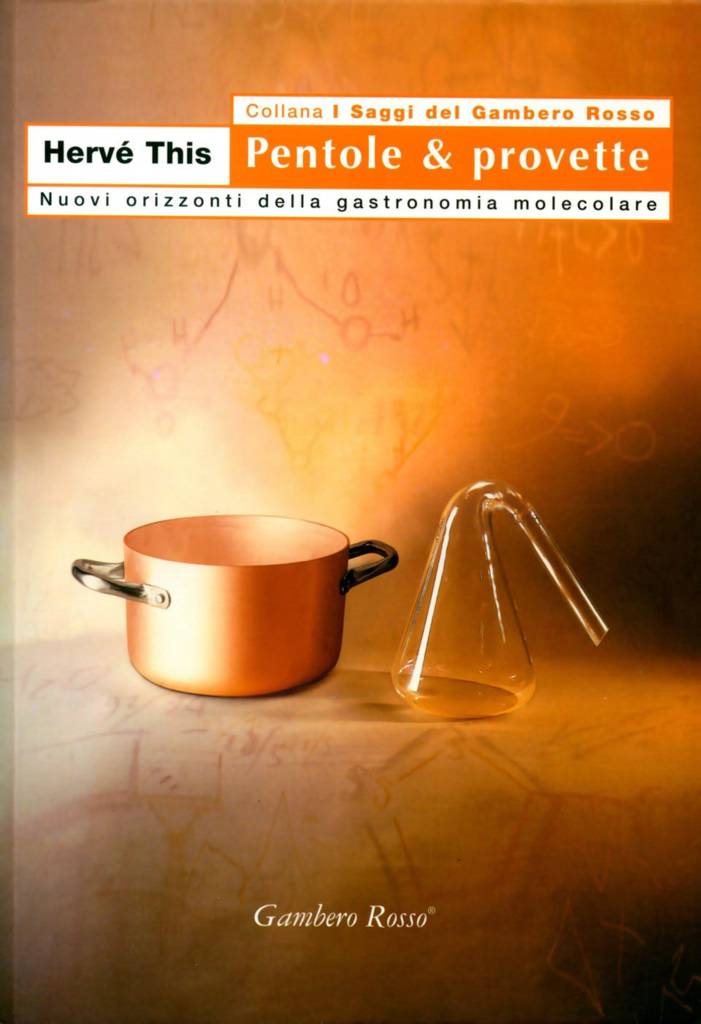 filter, heating, cooling slowly or abruptly, stir, bring to boiling, dilute, add ice, place in refrigerator. They are everyday gestures in any chemistry laboratory anywhere in the world. And they are the same steps that anyone does in the kitchen, the most famous chef of the housewife. Not surprisingly, the chemical laboratory speak jokingly of "recipes" when they follow procedures developed to synthesize una molecola. Non deve stupire, perciò, se un chimico-fisico appassionato di gastronomia decide di mettere la scienza al servizio della buona cucina. Hervé This lavora all' Istitut National de la Recherche Agronomique a Parigi e tiene da anni una rubrica di "scienze in cucina" per Pour la Science , edizione francese di Scientific American . Il suo Pentole & Provette sta diventando rapidamente un testo sacro della "gastronomia molecolare", l'insolita disciplina che studia la buona cucina dal punto di vista dei processi chimici, fisici e biologici che avvengono nelle pentole, nelle padelle e nel resto dell'attrezzatura cuisine. It may seem strange that on the Sciences are talking about a book where mayonnaise, soup, souffle and jams are the masters. But it is at least as strange that a text that describes the cooking of meat through lareazione Maillard protein, and blackening of the fruit cut by the action of polyphenol oxidase is one of the essays published by Gambero Rosso. Yet Hervé This tells us that there is no contradiction: what if the food is not the art of physical and chemical processes that occur during the preparation and tasting the food? The book is divided into four sections consisting of easy chapters a couple of pages each. First we will investigate sayings, proverbs and cooking traditions: it is true that to make the broth the meat must be soaked in cold water? And that egg whites do not mount if you change the direction of rotation during the operation? And because it is said that the dumplings are cooked when they float? Sometimes the advice of the tradition are the comfort of scientific inquiry, are sometimes blatantly contradicted by the experiment, and find that to prepare a delicious broth does not affect the initial temperature of the water. So how to put a teaspoon in the neck of an opened bottle of sparkling wine or champagne will not absolutely prevent the loss d'effervescence, despite popular belief states that. The second section explores the physiology of taste, and we learn that the mouth identifies only five flavors: the four "classic" (sweet, salty, bitter, sour), plus the latest addition, the ' umami (Japanese for simply means "taste"), which we could identify roughly in flavor. Flavor to another already known for centuries to oriental cuisine which often uses the characteristics of MSG added to foods, umami taste stimulator. The physiology of taste is actually more complex, This continues, for example There seems to be five different types of "bitter", each with its specific receptors. The third part of the book is dedicated to exploring and modeling of many food processes, from the preparation of jams and jellies to that of the white sauce, where it is suggested, on strictly scientific basis, avoiding the formation of clots, each of shame cook. The wine of course could not escape the scientific curiosity of a French physical-chemical, and several chapters are dedicated. The fourth part, "a food for tomorrow" is perhaps the most challenging. If science is able to investigate the mechanisms of food, why not provare a modificare e migliorare le ricette della tradizione in base alle conoscenze acquisite? O addirittura inventare nuove ricette? Per esempio, la crema Chantilly è una mousse preparata sbattendo la panna con la frusta in un recipiente freddo. Analizzando il processo, This si chiede se si possa creare un "cioccolato Chantilly". E, in un attimo, ecco fatto! Subito preparata una mousse di cioccolato che, contrariamente a quella classica, non ha bisogno di panna fresca o albume montato a neve. Alla fine della lettura del libro rimane solo un piccolo rimpianto: This è francese, e giustamente si addentra nei segreti della gastronomia transalpina, tra foie gras e Champagne, reblochon and quiche lorraine. The Italian cuisine is equally interesting (and tasty) and it would be nice that sooner or later someone will tell the same passion with the chemistry of the thermodynamics of pesto or pizza ...


0 comments:
Post a Comment